
The Symbiotica Experimental Guide Series
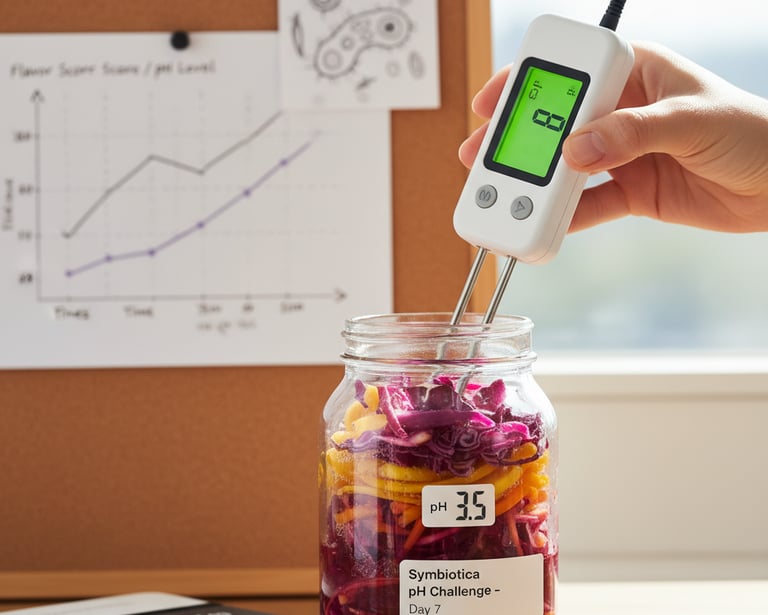
1. The Challenge: Mapping Flavour and Sourness Over Time
This experiment provides a direct, measurable way to demonstrate the invisible work of wild microbes in Symbiotica.
The Scientific Principle: The production of lactic acid and acetic acid by the microbes directly lowers the pH of the ferment, which, in turn, creates the desirable sour and complex flavours.
The Setup: A simple sauerkraut or vegetable pickle using Symbiotica as the starter.
The Protocol (The Experiment):
Hypothesis: The lower the amount of the brine, the greater the perceived sourness and complexity of the flavour.
Materials: Symbiotica product, vegetables, salt, a digital meter (easily accessible online), and small, labelled tasting jars.
The Data Collection: The audience takes a reading and a subjective "Taste Score" (e.g., scale of 1-10 for Sourness and Complexity) at Day 3, Day 7, Day 14, and Day 21.
The Analysis: Provide a simple, downloadable Data Chart for them to plot their readings against their Taste Scores, allowing them to visualise the flavour-science relationship.
The Hook: "Witness the exponential power of the Symbiotica culture. You won't just taste the science—you'll chart it."
2. The Salt Spectrum Test: How Concentration Affects the Microbial Population
This guide focuses on the principle of selective pressure—a core concept in microbiology and evolution. The salt level acts as the decision-maker for which microbes thrive.
The Scientific Principle: Higher salt concentrations inhibit undesirable moulds and yeasts, creating an environment where the beneficial, salt-tolerant lactic acid bacteria (LAB) can dominate, influencing the final texture and stability of the product.
The Setup: Fermented hot sauce or a traditional brined pickle.
The Protocol (The Experiment):
Hypothesis: A higher salt concentration will result in a firmer texture and a slower, more controlled fermentation rate, leading to a different final flavour.
Materials: Symbiotica, chillies/vegetables, and three fermentation vessels.
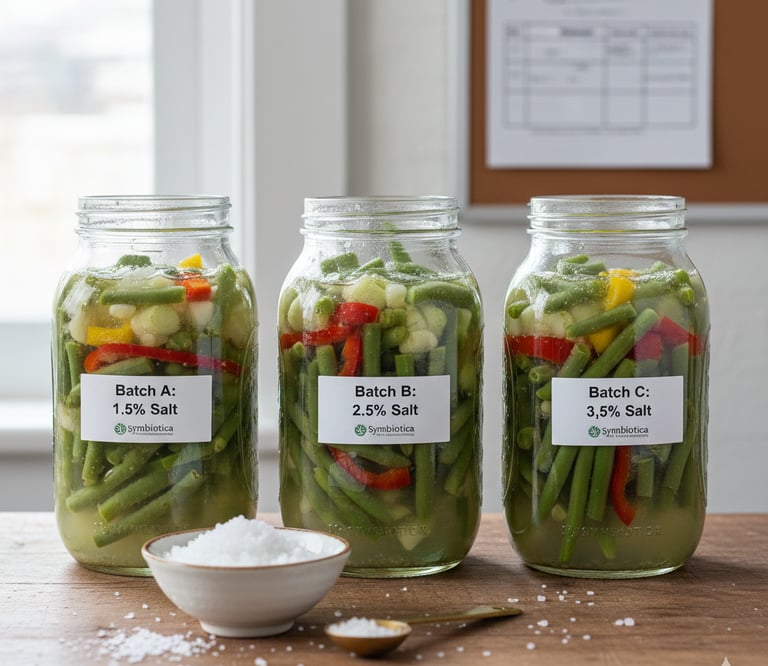
The Variables: Prepare three identical batches, but vary the salt concentration:
Control (Batch A): 1.5% salt by weight.
Test 1 (Batch B): 2.5% salt by weight.
Test 2 (Batch C): 3.5% salt by weight.
The Data Collection: The audience records the time it takes for active bubbling to begin in each batch (the Latency Period) and subjectively rates the Texture (e.g., scale of 1-5 for crunchiness) and Flavour Profile of each batch after 14 days.
The Hook: "You are the microbial architect. Discover how a single variable—salt—creates three vastly different ecosystems of flavour."
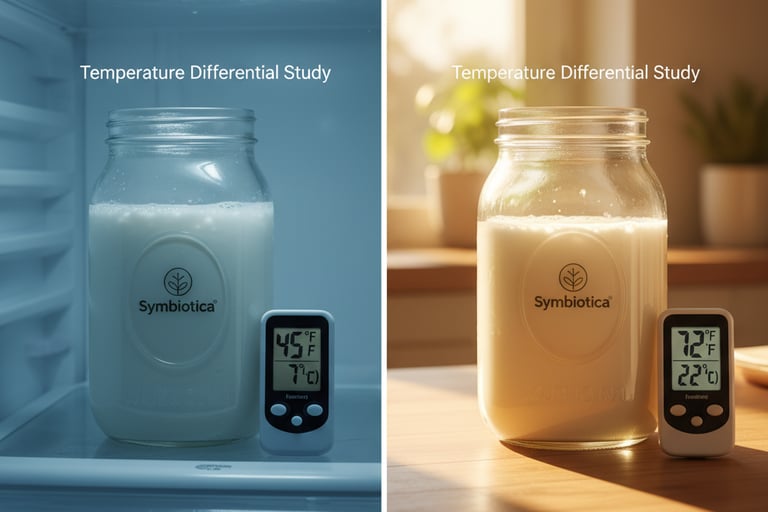
3. The Temperature Differential Study: Engineering Texture and Aroma
This experiment brings the environmental conditions of fermentation into sharp focus, mimicking controlled laboratory studies.
The Scientific Principle: Temperature dramatically affects the metabolic rate of microbes. Lower temperatures favour specific bacteria that produce more subtle and complex aromas, while higher temperatures accelerate activity, often leading to a sharper and simpler sourness.
The Setup: A simple fermented soda or cultured dairy product.
The Protocol (The Experiment):
Hypothesis: Fermenting at a lower temperature will produce a softer texture and more complex, nuanced aroma.
Materials: Symbiotica, base liquid, sugar/milk, and two identical fermentation vessels.
The Variables: Place the two batches in different, stable temperature environments:
Batch A (Low Temp): Refrigerator or cool pantry
Batch B (Room Temp): Standard kitchen counter
The Data Collection: The audience measures the final Texture/Viscosity (e.g., how thick the soda is, or how firm the yoghurt is) and records a detailed description of the Aroma after 48 hours.
The Hook: "Control the climate, control the culture. Understand the thermal engineering behind the Symbiotica process and unlock new flavour dimensions."
© 2026. All rights reserved.